Over six days, from November 12 to 17, 2026, the FAA grounded flights nationwide, Microsoft 365 had an outage lasting about a day, and Chase and other banks slowed down. The NSA's classified internal network slowed or partly failed too. The obvious question was whether something coordinated was going on.
See every event on one timeline
In the weeks before and during those outages, Europe dealt with attacks on supermarket fridges, and Norway's energy company Equinor disclosed an ongoing cyberattack. This report sets out what is on the record, what officials say and what is still unknown, so you can weigh it yourself.
Two things need separating. The first, a wave of documented hacking by government-linked and criminal groups, is confirmed and serious. The second, any link between that hacking and the US outages, is unproven either way.
- The FAA, Microsoft, Chase, United and the NSA have each given an explanation, from a flood of network traffic at the FAA to a software bug at Chase. None says it was attacked. On November 18, the Director of National Intelligence, Jay Clayton, told a House committee the outages were "not a coordinated or state-sponsored attack," Fox News reported, and Clayton has tied the NSA's outage to a software patch, The Record reported. Those are stated positions, not proof. The FAA has paused installing the routers involved and has not yet found the root cause.
- The outages happened close together in time (a correlation), which is worth investigating. Nobody has shown that one thing caused another (causation). The evidence that could settle it either way is listed under "What would settle it."
- CrowdStrike, a security company, says a hacking operator it links to China used ARTEX against more than 200 organizations over 11 days from October 17. ARTEX is an AI tool built for penetration testing (authorized hacking). CrowdStrike confirmed break-ins at nine of the organizations. The tool's author denies involvement.
- The FBI said on November 13 that a variety of malicious actors have used ARTEX since at least August to automate break-ins, from scouting targets through data theft. Its warning came out the same day as the FAA ground stop, but it does not mention that or any other US outage. On November 17, an FBI official said ARTEX does not appear connected to the recent outages, ABC News reported.
- We examined the other code ARTEX's developer has published: a platform for scouting targets ("recon") rewired so AI can run it, add-ons ("plugins") that install with no check that they are genuine, and an AI agent engine modeled on Claude Code, Anthropic's coding assistant. All of it is dual-use, serving defenders or attackers, and none of it is the attack tool.
- In Europe, attackers tampered with supermarket fridges in two waves. France blames the first wave, in French stores in October, on an Iran-linked unit; Iran rejects that. No government has said who was behind the second, which reached at least 11 countries from November 1. No source we found links these to ARTEX or the US outages.
- A Taiwanese official said preliminary investigations tied some recent attacks there to ARTEX. India's cyber agency listed ARTEX among one attack crew's tools, The Register reported. Singapore's cyber agency says reported incidents have tripled since September but do not appear coordinated.
- In June, Anthropic released Mythos 5, which it calls the strongest AI model at cybersecurity, only to vetted defenders. Three days later, to comply with a US government order citing national security, Anthropic switched it and the public version, Fable 5, off for everyone; Mythos 5 returned for some US organizations on June 26 and Fable 5 worldwide on July 1. Our count of press-reported attacks starts rising that same week, when other AI models were also released, though the rise may reflect faster logging rather than more attacks. No source links Mythos 5 to any attack. A Chinese lab says its downloadable model matches Mythos 5 at finding flaws, and one attacker ran that model in sessions beside ARTEX. Whether restricting Mythos helped or hurt is still open; see "Where Anthropic's Claude and Mythos 5 fit."
- Recorded attack activity has risen, but our check of public data found no statistical evidence linking ARTEX to the rise; with only about 20 weeks of data, only a strong link would have shown up. One narrow count, exploited flaws in firewalls and similar network-edge devices, did rise well above forecast. We defined it during the analysis, it does not survive the strictest correction for many tests, and the data cannot show why it rose: a timing fact, not evidence of a link.
Everything on one timeline
Events sit side by side below because of their dates, not because anyone has shown a connection. The timeline gathers 80 of the main dated events in this report, from Microsoft's 2021 account of stolen source code to officials' statements on November 18. Each row is color-coded by kind of event and linked to its source.
The US outage week is shaded, and "reported" marks rows that rest on a single source or are not yet confirmed. On wider screens, the interactive version lets you switch between the long view, the outage week and a plain list, hide kinds of event, and select any event to see its source. Our longer worldwide incident log is in Appendix C.
Open the interactive timeline on its own pageThere the chart works on phones too: swipe along it and tap any event for its details and source.
80 sourced events, February 2021 to 18 November 2026. Each links its source.
February 2021
- Microsoft says hackers in the SolarWinds intrusion obtained some Azure, Intune and Exchange codeEarlier source-code theftmicrosoft.com
March 2024
- Microsoft says Russia-linked Midnight Blizzard accessed some of its source code repositoriesEarlier source-code theftbleepingcomputer.com
October 2025
- F5 source code theft disclosed; CISA issues an emergency directiveEarlier source-code theftcisa.gov
March 2026
- Claude Code's source code is exposed by an Anthropic packaging errorAI models and labsventurebeat.com
- ARTEX's developer copies a reconstructed version of Claude Code's source on GitHubARTEX and its toolkitgithub.com
April 2026
- Anthropic keeps Mythos Preview from the public over its hacking skill; vetted defenders onlyAI models and labsanthropic.com
- Bloomberg: a small group reached Mythos Preview without permission via a contractor; no attacks reportedAI models and labsReportedthenextweb.com
- DeepSeek releases V4-Pro and V4-Flash in preview as downloadable modelsAI models and labsapi-docs.deepseek.com
June 2026
- Suspected Chinese operators use Claude Code with DeepSeek against targets in four countries, including government systemsHacking campaignshunt.io
- Anthropic releases Fable 5 to the public and Mythos 5 to vetted defenders onlyAI models and labsanthropic.com
- A well-known jailbreaker claims to break Fable 5's safeguards; Anthropic disputes itAI models and labsReportedsecurityweek.com
- ARTEX's developer adds AI-agent control to its recon platform, ScopeSentryARTEX and its toolkitgithub.com
- US order citing national security; Anthropic switches off Fable 5 and Mythos 5 for everyoneOfficial statementsanthropic.com
- Moonshot AI releases Kimi K2.7-Code, a downloadable coding modelAI models and labsReporteddigitalapplied.com
- Zhipu releases GLM-5.2 as a downloadable modelAI models and labsdocs.z.ai
- US lifts the controls; Fable 5 returns worldwide on 1 Jul behind a stricter cyber filterOfficial statementsanthropic.com
July 2026
- Microsoft starts rolling out the server change it later blamed for its November outageUS outagesoffice-watch.com
- Earliest commits in Norma, the engine a researcher says ARTEX is derived from; Claude credited as co-authorARTEX and its toolkitgithub.com
- ARTEX is published on GitHubARTEX and its toolkitcensys.com
August 2026
- FBI: malicious actors have used ARTEX since at least AugustHacking campaignsic3.gov
- Zhipu releases GLM-5.3 and says it matches Mythos 5 at finding vulnerabilitiesAI models and labsdocs.z.ai
- Coast Guard, FBI cyber teams board tanker over a possible compromise; no operational disruptionAt seacbsnews.com
September 2026
- Two Turkish ships collide in the Sea of Marmara; one sinks, ten crew missingAt seadenizde.com.tr
- Anthropic: Zhipu's GLM-5.3 nearly matches Mythos Preview at building exploits, with weak safeguardsAI models and labsanthropic.com
October 2026
- Amazon decoys begin logging AI agents it ties to ARTEX (to 5 Nov; reported 13 Nov)ARTEX and its toolkitReportedaws.amazon.com
- CrowdStrike: South Korean bank attackers ran ARTEX mainly on DeepSeek, beside Claude CodeHacking campaignscrowdstrike.com
- ARTEX's developer denies involvement and takes the project closed-sourceARTEX and its toolkitgithub.com
- Fridge controllers tampered with at about 700 French supermarketsEuropepbs.org
- South Korean police arrest a gang leader; BleepingComputer reports the gang used ARTEXHacking campaignsbleepingcomputer.com
- VAPOR PANDA (China-linked, per CrowdStrike) begins an 11-day ARTEX campaign against 200+ organizationsHacking campaignscrowdstrike.com
- Microsoft reports Storm-0940 used ARTEX in a supply-chain attack via ConnectWiseHacking campaignsmicrosoft.com
- Worldwide: AI-found flaws in PHP, common website software, widely exploited as fixes shipHacking campaignsfortune.com
- Cruise ship hits moored ships in Bremerhaven; police cite wind and investigate captainAt seatagesspiegel.de
- Lumen says China's Volt Typhoon ran a hijacked-router relay network, 2023 to 2026Hacking campaignsReportednextgov.com
- Worldwide: Cisco says a firewall VPN flaw is exploited to force device restartsHacking campaignsbleepingcomputer.com
- Reuters: investigators treat August commissary freezer failures as suspected cyberattacks; Pentagon has not confirmedOfficial statementsReportedyahoo.com
- Check Point gateways exploited; servers wiped at Israeli organizations, wider wave elsewhere (disclosed 12 Nov)Hacking campaignsresearch.checkpoint.com
November 2026
- Second wave of fridge tampering begins, reaching at least 11 European countriesEuropealjazeera.com
- Taiwan: 427 abnormal Bank SinoPac transfers; bank later blames hackers using a vendor's settingsHacking campaignsmoney.udn.com
- EU agencies' joint statement on fridge attacks names no attackerEuropeenisa.europa.eu
- CERT-EU says AI-driven activity against EU institutions highly likely involved ARTEXEuropecert.europa.eu
- CISA, FBI and three other US agencies warn about exposed fridge controllersOfficial statementsic3.gov
- India: CERT-In warns of AI-assisted attacks on fintechs; reports say tools include ARTEXOfficial statementsReportedtheregister.com
- Check Point: one ARTEX operator hits Opus 5.5's guardrails, then switches to Chinese modelsHacking campaignsresearch.checkpoint.com
- Docker removes a backdoored ARTEX copy pulled about 9,131 times, StepSecurity saysARTEX and its toolkitReportedstepsecurity.io
- Microsoft: Storm-3358 targets financial sector with ARTEX; no source ties it to US outagesHacking campaignsmicrosoft.com
- France blames Iran-linked unit Shahid Kaveh for the October fridge attackEuropepbs.org
- GPS interference hits dozens of aircraft over the Netherlands; no official cause givenEuropeReportednltimes.nl
- Japan: record 233 disclosed cyber incidents in October, per Trend Micro dataHacking campaignsReportedtokyoreporter.com
- Anthropic releases Fable 5.2 to all users; Mythos 5.2 only to vetted organizationsAI models and labsanthropic.com
- Iran's Foreign Ministry rejects France's accusation as baselessEuropecnbc.com
- Lithuanian Customs shuts a portal after an attack; EU import system access disruptedEuropetherecord.media
- Taiwan: an official says some recent attacks on 10+ firms involved ARTEX (preliminary)Official statementsfocustaiwan.tw
12–17 November 2026: the US outage week
Thursday 12 November
- Microsoft 365 outage begins, hitting Outlook and Exchange OnlineUS outages16:20 UTC 12 Nov to 16:10 UTC 13 Novoffice-watch.com
- Bulk carrier strikes Tacony-Palmyra Bridge on the Delaware River; Coast Guard investigating causeAt seagcaptain.com
- German drone maker Quantum Systems contains an intrusion; Bundeswehr grounding reportedEuropeReportedresiliencemedia.co
Friday 13 November
- FBI publishes its ARTEX warning (FLASH-20261113-001); it does not mention the US outagesOfficial statementsic3.gov
- Microsoft says its outage has endedUS outagesoffice-watch.com
- Tanker hits cruise ship in New Orleans; NTSB: rudder stuck, reason not yet knownAt seantsb.gov
- FAA technical problem leads to a nationwide ground stopUS outagesfaa.gov
- Singapore: incidents tripled since September, not a coordinated campaign, CSA saysOfficial statementsthestar.com.my
Monday 16 November
- Chase online banking slows; Chase later cites a software bugUS outagesaljazeera.com
- United technology problem delays about 600 flights; fixed that eveningUS outagestime.com
- Worldwide: Optimizely flaw lets an attacker plant card- and crypto-stealing code on about 178 organizations' sites, including BBC and CNNHacking campaignsbleepingcomputer.com
- Australia: Coles investigates a cyber incident; says it has found no sign that data was takenHacking campaignsia.acs.org.au
- Google reports attackers used ARTEX and similar frameworks over the past quarterARTEX and its toolkitcloud.google.com
Tuesday 17 November
- NSA's classified network degraded; NSA cites scheduled routine maintenanceUS outagescbsnews.com
- Equinor discloses an ongoing cyberattack on some of its IT systemsEuropeequinor.com
- Apple services outage reported; Apple cites an internal updateUS outagesReportedsecurityaffairs.com
- FBI official: ARTEX does not appear connected to the recent outagesOfficial statementsReportedabcnews.com
- FAA pauses router installations; it has not yet found the root causeUS outagesabcnews.com
- DNI Clayton: patching left some NSA systems unable to come back upOfficial statementstherecord.media
- Washington Sun, citing unnamed sources: fixes for AI-found flaws caused outages; Reuters could not verifyOfficial statementsReportedwashingtonsun.com
- Optimizely report: attacker abused a sign-up flaw to act as administratorsHacking campaignspages.optimizely.com
- Rubio, in Manila: 'zero evidence' of nefarious actors; 'not under systemic attack'Official statementstbsnews.net
November 2026
- DNI tells House committee the outages were not a coordinated or state-sponsored attackOfficial statementsfoxnews.com
- FAA administrator: 'I take full responsibility'; root cause still undeterminedUS outagesclickorlando.com
- Equinor: not a virus; too early to say when systems are restoredEuropeequinor.com
- Visa says a third-party provider had a security incident; its systems unaffected, TechRadar reportsHacking campaignsReportedtechradar.com
- GAO report: in April tests, four AI chatbots gave attack plans despite safeguardsAI models and labsabcnews.com
No events for the categories shown.
Breaks in the axis skip periods with no events. The shaded band is the outage week; each number in it counts one lane’s events. Dashed spans: month known, day not.
Known start and endKnown timeDate only, time not givenAll times UTC
Events are placed by date only. Being on the same line does not mean one caused another.

Source code theft is confirmed
Set the outages aside for a moment. Each organization's own explanation is under "What happened in the outages," below, and none says it was attacked. A separate trend is well documented.
Since at least 2020, government-backed intruders have repeatedly gone after the source code of the very vendors whose products critical infrastructure relies on. Source code is the human-readable instructions software is built from.
- Microsoft: during the 2020-21 SolarWinds intrusion, hackers obtained some source code for small parts of Azure (Microsoft's cloud platform), Intune (device management) and Exchange (email), Microsoft said in February 2021. In March 2024, Microsoft said the same group had accessed some of its stored source code ("repositories") after breaking into a test account in late 2023. Microsoft calls the group Midnight Blizzard; it is also known as APT29 and is linked to Russia's foreign intelligence service, the SVR. Which code was accessed that time has not been made public.
- F5: hackers working for a government had long-term access to the systems where F5 develops its BIG-IP products. They stole part of the BIG-IP source code and information about undisclosed vulnerabilities, flaws not yet made public, F5 said. On October 15, 2025, CISA, the US government's cyber defense agency, issued an emergency directive, an order to federal agencies to act, and warned that access to the code could help the attackers find hidden flaws and build exploits.
- Juniper: in the older 2015 ScreenOS case, Juniper's firewall software carried a real backdoor, a secret way in planted on purpose. Bloomberg reported in 2021 that it was tied to Chinese hackers who repurposed an NSA-origin mechanism.
Nothing on the record ties any of these cases, Juniper's 2015 backdoor included, to the November outages.

An AI pentest tool abused for espionage, according to security firms
Then there is ARTEX. The security firm Censys traces it to the developer behind ScopeSentry, which Censys describes as a widely used Chinese platform for mapping an organization's internet-facing systems ("asset discovery"). The developer published ARTEX on GitHub, a public site for sharing code, on July 26, 2026.
On November 13, the FBI issued a public warning, which it calls a FLASH. It said a variety of malicious actors have used ARTEX since at least August 2026 against organizations worldwide. They used it to automate intrusions "from reconnaissance through data exfiltration," that is, from scouting a target to carrying off its data.
Some intrusions went from first targeting to privileged, administrator-level access in under three hours, the FBI said. The warning does not mention the US outages.
In an October 29 report, CrowdStrike said an operator it assesses as linked to China began using ARTEX on October 17. CrowdStrike calls this operator VAPOR PANDA; security firms give hacking groups their own code names, so one group can have several. Over the next 11 days, VAPOR PANDA targeted more than 200 organizations in at least 14 countries, including government agencies, telecom providers and defense companies.
CrowdStrike confirmed post-exploitation activity, meaning actions inside a network after breaking in, at nine of them.
Figures from CrowdStrike's October 29 report. ARTEX's author denies involvement.
CrowdStrike says the operator ran ARTEX mainly with the DeepSeek AI model and drove multiple intrusions in parallel. The security firms Check Point and SafeBreach have reported on the same campaign.
Not just one group
Microsoft says a government-backed group it calls Storm-0940 used ARTEX to get in through a trusted supplier, the IT software company ConnectWise. CrowdStrike says Storm-0940 is distinct from VAPOR PANDA. The FBI says the attack led to attempted sign-ins at more than 2,250 downstream tenants, the cloud setups of customers further down the chain.
Researchers at the security firm Wiz also found ARTEX used in attacks aimed at services that manage workers' logins, such as Okta and Microsoft Entra, Cybersecurity Dive reported; that does not mean either company was breached.
Criminals use it too. Microsoft says Storm-3358, which it describes as Cambodia-based and financially motivated, has used ARTEX against the financial sector. In South Korea, police say a gang breached more than 90 organizations, and the cyber news site BleepingComputer reports that it used ARTEX; its leader was arrested on October 15.
In Europe, CERT-EU, the cyber team for the EU's own institutions, said on November 5 that AI-driven activity against them "highly likely" involved ARTEX, an analyst's judgment that names no victim or attacker. CrowdStrike says VAPOR PANDA targeted government offices in one European country. The Dutch security group DIVD confirmed that a September hack aimed at DIVD itself used ARTEX, Cybersecurity Dive reported.
In Asia, an official at Taiwan's digital ministry said on November 11 that preliminary investigations linked nearly half of recent attacks on more than 10 Taiwanese businesses to AI, some involving ARTEX. India's cyber agency, CERT-In, listed ARTEX among the tools of a crew attacking financial technology firms, The Register reported. In Japan, TBS reported that unnamed researchers believe ARTEX may have been involved in attacks on about 80 companies.
Amazon's threat intelligence team said on November 13 that decoy servers it runs recorded, between October 3 and November 5, AI agents hunting for access keys to AI services and trying to fool identity checks at two cryptocurrency exchanges with deepfake video. Amazon assesses with moderate confidence that the agents ran on ARTEX and were used by separate China-linked groups; it says it did not watch the activity as it happened and cannot confirm what the agents achieved. Google said on November 16 that attackers are running ARTEX and similar AI frameworks in multi-stage intrusions, and that for the first time it had seen attackers fully automate finding and exploiting flaws "without a human in the loop."
ARTEX is not the only such tool: researchers at TrendAI and the security firm Kaspersky describe campaigns run with another AI platform, CyberStrikeAI.
The developer took ARTEX's original GitHub page offline in October, but the FBI says ARTEX stays available through community forks (modified copies others publish), archived copies and a commercial version, ARTEX PRO. By early November, researchers had found more than 1,600 ARTEX control panels (the screens used to run it) reachable from the internet, the FBI says; Censys counted 1,465 on November 3-4. A copy of ARTEX posted to Docker Hub, a public library of ready-to-run software, carried a hidden back door and was downloaded about 9,131 times, the security firm StepSecurity reported. Docker removed that copy and an identical second one on November 5, StepSecurity says.
ARTEX's author denies involvement and has stopped publishing its code ("closed-source"). Where the developer or the platform comes from is not evidence of involvement.

Inside the developer's toolkit
ARTEX went closed-source before we could obtain it, so what we report about it comes from the firms that analyzed it. We could obtain the developer's 20 other public projects ("repositories") under the GitHub account Autumn-27, and examined their saved change histories without building or running any of the code. This describes what the code contains, not who has used it.
Together, these are the parts an AI agent would need to scout targets on its own (an "autonomous reconnaissance agent"). Each is dual-use, with legitimate value for defenders on its own. None of what we examined is the attack tool itself, and we found nothing in it that refers to the November outages.
In an October 8 statement on the account's profile, the developer said the attacks had "nothing to do with the tool's author." The full code review and our method are in Appendix A.
Where Anthropic's Claude and Mythos 5 fit
A question this story raises is whether it traces back to Anthropic, the company behind the Claude AI models, and to Mythos 5, the model Anthropic calls the strongest in the world at cybersecurity. Here is what the record shows, by date. Disclosure: this section is about Anthropic, and Anthropic's own AI, Claude, helped research and draft it and the rest of this report. Recent Breaches' publisher is a paying Claude customer.
Before June
On March 31, Anthropic exposed the source code of Claude Code, its coding tool, in a software package, by its own account by mistake, and ARTEX's developer copied a reconstructed version that day (more below). On April 7, Anthropic announced Mythos Preview and kept it from the public because of its skill at finding and exploiting software flaws, offering it only to vetted defenders. A small group reached Mythos Preview without permission that same day, through a contractor's systems, Bloomberg reported two weeks later. The group reportedly had used the model regularly since and described its motive as curiosity; Anthropic said it found no sign the access went beyond the contractor's environment or affected its core systems, and no attacks were reported. We found no report of Mythos 5 itself leaking.
The June week
On June 9, 2026, Anthropic released two versions of one model. Claude Fable 5 went to the public, with filters that pass hacking-related requests to an older model. Claude Mythos 5, the same model with some safeguards lifted, went only to a small number of trusted partners in Project Glasswing, Anthropic's program for defenders, whose members include AWS, Microsoft, Google and CrowdStrike.
On June 12, three days later, the US government ordered Anthropic, citing national security powers, to cut off all access to both models by foreign nationals, Anthropic said. The Commerce Department issued the order, according to the policy institute CSIS; its text has not been published. Anthropic says it had no reliable way to check users' nationality in real time, so it switched both models off for everyone. Anthropic says the order gave no specific details, and that it came after the government learned of a report by Amazon researchers describing a narrow way around Fable 5's safeguards that got the model to find software flaws and, in one case, to write code showing how one could be exploited. Anthropic called the flaws minor and already known, called the order a misunderstanding, and complied. None of the sources cites an actual attack.
Mythos 5 was allowed back for a set of US organizations on June 26. The controls were lifted on June 30, and Fable 5 returned worldwide on July 1 with a stricter filter that Anthropic says blocks the reported technique in over 99 percent of cases but also flags more ordinary coding requests. We found no source saying the model itself was made less capable; what changed is which requests it will answer. Some users said the relaunched Fable 5 felt weaker; BleepingComputer said its understanding was that the model itself had not been weakened, and it saw the filters handing more requests to the older model. In September, Fable 5.1 loosened them: Anthropic says the new filters raise 60 percent fewer false alarms and let the model find software flaws, though not write exploits for them.
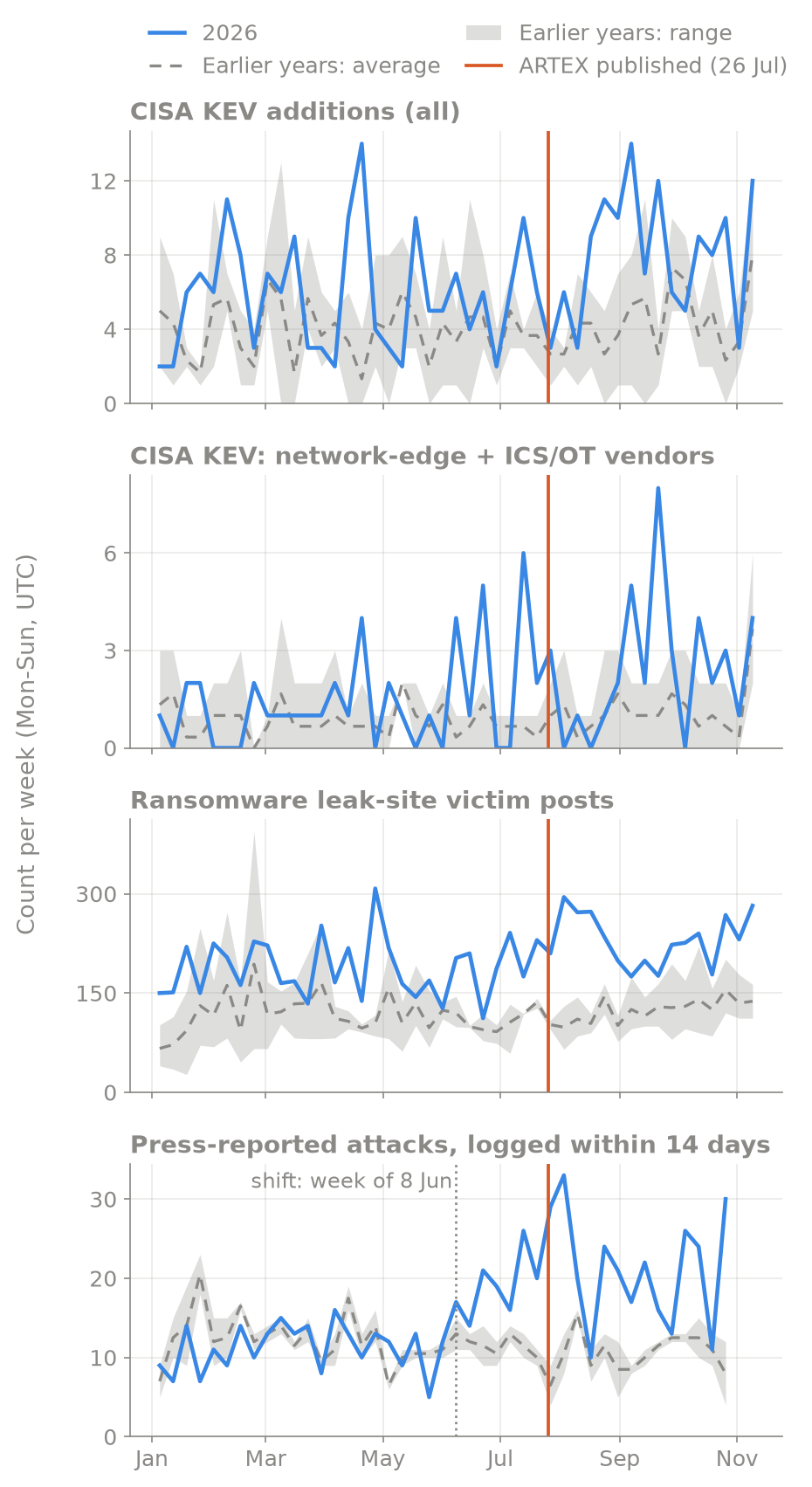
Two of our data series also shift that week. Counting only attacks our tracker logged within 14 days, press-reported attacks began rising in the week of June 8; that may reflect faster logging rather than more attacks, and the data cannot tell which. A count of actively exploited flaws in products from makers of network-edge and industrial equipment also has its best-fitting single shift that week. Our narrower count of exploited flaws in firewalls and similar edge devices has its best-fitting shift in the week of September 7 instead, though with counts this small that dating is unstable (Appendix B). Timing alone does not show that any of these events is connected. Other dated events in and just after that week:
- June 8 to 12: suspected Chinese operators used Claude Code, Anthropic's coding tool, with DeepSeek's model doing the reasoning, according to the security firm Hunt.io. It says they broke into government systems in Afghanistan and Thailand, attacked companies in Taiwan and began building copies of two US local government websites, including a fake login page, apparently for phishing. Hunt.io does not mention ARTEX.
- June 10: a well-known jailbreaker (someone who tricks AI models into ignoring their safety rules) claimed to have broken Fable 5's safeguards; Anthropic said the post did not show a jailbreak.
- June 10 to 12: ARTEX's developer added a connection (MCP, an open standard Anthropic first created that is now widely used) that lets AI agents run ScopeSentry, its tool for mapping a target's internet-facing systems, and released it on June 12.
- June 12: the Chinese lab Moonshot AI released Kimi K2.7-Code, a coding model anyone can download.
- June 16: the Chinese lab Zhipu released GLM-5.2, another model anyone can download.
The main models security firms name in ARTEX attacks came out before or after that week: DeepSeek's V4 family in preview from April 24, then Zhipu's GLM-5.3 on August 18 and DeepSeek V4.1 Flash on September 10.
Where Claude and Mythos 5 appear in the ARTEX record
- Help writing the engine. An independent researcher says ARTEX's agent is derived from Norma, an agent engine by the same developer. As of November 18, Norma's public history credits Claude as a co-author in 18 of its 67 changes ("commits"): Opus 4.8 in 12, Sonnet 4.6 in 3, Sonnet 5 in 1 and the Claude Code tool in 2. None credits Fable 5 or Mythos 5, and the credits are the developer's own labels. Norma's code comments map parts of it to Claude Code, whose reconstructed source the developer's account had copied on March 31. The security firm Nextron, quoted by the researcher, says Norma is neither exclusive to ARTEX nor malicious on its own.
- A tool used beside ARTEX. On servers used by an attacker who targeted South Korean banks, CrowdStrike found records of Claude Code sessions next to ARTEX files. It names DeepSeek V4.1 Flash as ARTEX's main model there, and says Zhipu's GLM-5.3 and xAI's Grok 4.6 ran other Claude Code sessions. It also says the attacker "asked Claude" for help, including where stolen Korean data is usually sold, but it does not say which model answered or whether any refused.
- Mythos 5 as the yardstick. Zhipu's release notes for GLM-5.3 say the model matches Mythos 5 at reviewing code and finding vulnerabilities, and that in real-world testing with security teams it found 2,436 of them. That is Zhipu's own claim. On September 29, Anthropic's researchers said GLM-5.3 built working exploits at a rate close to that of Mythos Preview, the earlier restricted version (50 of 410 attempts against 56 on one test, and somewhat below it on another), with safeguards that were easy to get around. GLM-5.3 is one of the models CrowdStrike names in the South Korean bank attacks.
- A refusal. Check Point says the only guardrail refusals it saw in the ARTEX setups it examined came from Anthropic's Opus 5.5, after which the operator switched to Chinese models with fewer safeguards.
- Copying. Anthropic's September report says none of the misuse it caught from December 2025 to August 2026 involved its Fable or Mythos-class models, apart from one case of copying. It says Chinese AI labs tried to copy Claude's skills by harvesting its answers to train their own models ("distillation"). It says that ahead of GLM-5.3's release, Zhipu went after Fable's cyber skills first, gave up when Fable's safeguards got in the way, and switched to Anthropic's older Opus 4.6 and another US lab's leading model because it judged their safeguards weaker. These are Anthropic's claims about a competitor; we have not seen Zhipu's response. On September 8, in a joint advisory, the NSA, FBI and CISA also accused six Chinese AI companies, including DeepSeek and Zhipu's Z.ai, of copying US models including Claude in this way; China's Commerce Ministry called the claims groundless and warned of countermeasures.
- Earlier misuse. Anthropic has itself reported Claude being misused for hacking: in an August 2025 report, an extortion campaign against at least 17 organizations, and in a November 2025 report, a campaign detected that September that it attributes with high confidence to a Chinese state-sponsored group, against about 30 targets. Neither involves ARTEX.
What cuts against it.
- Our data counts by week, so it cannot show whether the June rise began before or after Fable 5 came out on June 9; the Hunt.io sessions, run with DeepSeek's model, began on June 8. The rise in press-reported attacks may reflect faster logging rather than more attacks, and our narrow count of exploited firewall and edge-device flaws shifts in September, not June.
- Mythos-class hacking skill was not new in June: Anthropic announced Mythos Preview, also limited to vetted defenders, on April 7.
- Mythos 5 was never public, and no source reports anyone using it outside the organizations Anthropic approved. Before the order, Fable 5 was public for only three days, behind its filters.
- The US order began and ended before ARTEX was published, and no source links it to ARTEX, any campaign or the outages. Its evidence is unpublished, and Anthropic says the technique behind it found only minor, already known flaws.
- The week was crowded: other labs released models too, and DeepSeek's V4 family, whose Flash models attackers used most with ARTEX, had been out in preview since April (the V4.1 Flash version the firms name followed on September 10).
- Zhipu's Mythos 5 comparison is its own claim. Anthropic's tests put GLM-5.3 close to the earlier Mythos Preview at building attack code, not to Mythos 5.
- The firms that examined ARTEX attacks name mostly Chinese models. Check Point says the only refusals it saw came from Anthropic's Opus 5.5, and CrowdStrike does not say which model answered the questions its attacker put to Claude.
- Growing pains and a coordinated campaign can look alike in counts like ours; our tests cannot tell them apart.
Did locking Mythos away help or hurt?
We have not decided, and the evidence does not settle it yet. Two things first. The June shutdown followed a US government order that barred foreign nationals; Anthropic says it switched the models off for everyone only because it could not check users' nationality in real time. Limiting Mythos models to vetted organizations since April is Anthropic's own policy. And Fable 5 and Mythos 5 are offered only as online services, not as files anyone can download, so the three days in June did not release the model itself; no source reports that anyone obtained it. Copying its skills by harvesting its answers, which Anthropic says Zhipu tried, is a separate issue covered above.
What would tell the two apart: how many misuse attempts the safeguards stopped, how much defenders found and fixed with Mythos models, and whether attacks run on open models such as GLM-5.3 keep rising. Only the second has any published figures, and they are Anthropic's own: in May it said 75 of the 530 serious flaws it had reported to open-source projects had been fixed, and in September that defenders had used Mythos Preview to find more than 10,000 vulnerabilities in critical software. No independent count of any of the three has been published.
A separate dispute, the Pentagon's March decision to label Anthropic a "supply chain risk," followed Anthropic's refusal to drop limits on using its models for mass surveillance of Americans and for fully autonomous weapons, according to Defense News; no source we found ties it to hacking. A federal judge in California ruled in August that the Pentagon had unlawfully branded Anthropic a supply-chain risk, but in September a federal appeals court in Washington, in a separate case, upheld a second, parallel designation.

What happened in the outages
Examined one at a time, each failure comes with an explanation from the organization involved, and most describe a technical fault. Officials say they see no sign of an attack. These are the organizations' and officials' stated positions, and some investigations, including the FAA's, are not finished.
Markwayne Mullin, the Homeland Security (DHS) Secretary, said on November 16 that, with 98 percent certainty, officials were not seeing a cyberattack, and called the outages all individually unrelated. Of the FAA failure, the Secretary also said officials were not ruling out a cyberattack, SecurityWeek reported.
On November 17 and 18, Jay Clayton, the Director of National Intelligence, said there was no evidence of a coordinated cyberattack. Patching for critical flaws found the month before "has caused some of these systems to not come back up," including at the NSA, Clayton said, The Record reported; Reuters reported that Clayton tied the NSA's outage to patches for a flaw in PHP, a widely used programming language, found with the help of AI. On November 18, Clayton told the House Homeland Security Committee: "They are not a coordinated or state-sponsored attack," Fox News reported. The NSA's own statement cites "temporary degradation during scheduled routine maintenance." Speaking to reporters in Manila on November 17 (November 18 there), Secretary of State Marco Rubio said there was "zero evidence" the outages were caused by "nefarious actors" and "We are not under systemic attack," Reuters reported.
Apple services also failed on November 17, a sixth outage that week, and Apple blamed an internal update, Security Affairs reported. Security Affairs says there is no evidence that the Apple or NSA outages were malicious.

Meanwhile in Europe, at sea and around the world
Europe and other regions had incidents of their own in the same weeks. No source we found links any of them to the US outages.
Supermarket fridges, tampered with in two waves
Many supermarkets run their fridges through controllers that can be reached over the internet. Attackers changed the settings on some so the units kept heating or defrosting, which can spoil stock. France's cyber agency, which listed Danfoss, Copeland and Dixell controllers among those affected, told owners to take them off the open internet and change default passwords.
- First wave, October 11-12: about 700 French supermarkets.
- Second wave, from November 1-2: stores in Belgium, Estonia, Finland, Ireland, Italy, Luxembourg, the Netherlands, Portugal and Sweden, Al Jazeera reported. Germany and Romania reported cases the next day and the UK soon after, bringing the count to at least 11 countries.
- Blood banks: France's blood service, EFS, said cold storage at three or more blood banks was hacked; monitoring caught it and no blood products were damaged.
On November 4, EU bodies including the cyber agency ENISA and the police agency Europol said refrigeration systems had been hit since October 11. Their joint statement named no attacker.
In the US, Task & Purpose reported on October 29, citing Reuters and unnamed officials, that investigators are treating August freezer failures at six or more military commissaries, the military's grocery stores, as suspected cyberattacks. The Pentagon has not confirmed that hackers were involved.
Who has been blamed, and who hasn't
The cyber news site The Record reports that US agencies had earlier identified Shahid Kaveh as another name for CyberAv3ngers, a group they tied to 2023 attacks on water-utility controllers (see Appendix D).
No government has said who was behind the November wave. Two pro-Russian groups of activist hackers ("hacktivists") posted claims on Telegram and soon deleted them, LIGA.net reported; no government has confirmed them. Romania's cyber director said there was no suspicion that a state actor, meaning a government, was involved there.
Norway's Equinor
On November 17, the energy company Equinor said it had detected an ongoing cyberattack on some IT systems, with no effect on operations and no sign that data was stolen. It has named no attacker, and no source we found links it to ARTEX or the US outages.
On November 18, Equinor said it had "gained a clearer understanding of how the attack was carried out and which systems have been affected," that it was not a virus attack and so could not spread, and that it was too early to say when its systems would be fully restored. Norway's National Security Authority told Reuters it is aware of the attack and is assisting Equinor, Riviera Maritime Media reported.
On the water
Several ship accidents made news from September to mid-November. Officials have described each one or said the cause is under investigation, and none has said hacking was involved.
- New Orleans, November 13: a tanker hit a docked river cruise ship; an investigator for the NTSB, the federal accident investigators, said its rudder got stuck, for reasons not yet known.
- Delaware River, November 12: a bulk carrier struck the Tacony-Palmyra Bridge; the Coast Guard is investigating.
- Sea of Marmara, September 2: two Turkish ships collided and one sank. A preliminary expert report blames a severe loss of awareness of their surroundings on both ships. It says the sunken ship's position beacon was off, faulty or affected by outside interference, without saying which.
Two items of background follow; neither is offered as the cause of the accidents above. A UK Marine Guidance Note reports a marked rise worldwide in GPS jamming, which blocks signals, and spoofing, which feeds receivers a false position.
Separately, in August, US Coast Guard and FBI cyber teams boarded a Texas-bound tanker. Its network, the Coast Guard said, showed signs of a possible breach ("indications of compromise"), with no operational disruption.
Around the world
Some attacks began at network-edge equipment, the devices where a network meets the internet. From October 30, attackers broke into Check Point security gateways that lacked fixes ("unpatched"), then wiped servers at some Israeli organizations. The security firm Check Point cannot say with high confidence who did it.
Cisco said attackers were exploiting a flaw that forces some of its firewalls to restart. In Japan, data from the security firm Trend Micro, reported by TV Asahi, counted a record 233 disclosed incidents in October. Singapore's cyber agency says reported incidents have tripled since September but do not appear coordinated.
Inside the outage week, on November 16, an attacker used a flaw in Optimizely, a service many companies use to test changes to their websites, to plant card- and crypto-stealing code on about 178 organizations' sites, including the BBC, CNN and Fox News. The security firm Report URI counted the sites; Optimizely says the attacker exploited a vulnerability, which it has fixed, and that the code was removed. The same day, Australia's Coles supermarket chain said it was investigating a cyber incident and had found no sign that data was taken. In its November 17 report, Optimizely says the attacker abused a flaw in its sign-up process to act as administrator users, that the security firm Mandiant is investigating, and that it cannot yet say whether card data was captured. No source links either to ARTEX or the US outages.
Visa told the news site Cybernews that a third-party provider it did not name had a cybersecurity incident and that "Visa's systems were not involved and were not impacted," TechRadar reported on November 18. A new ransomware group, n0n, claims to have taken data from Visa and JPMorgan Chase; that claim has not been verified. TechRadar wrote that JPMorgan "outright denied everything," pointing to the bank's statement to Reuters that its outage came from a software bug and that "there is no evidence it is cyber-related." No source links the claim to ARTEX or the US outages.
Our log of verified incidents is in Appendix C, and Appendix E sorts every row by the industry it touched, from banks and hospitals to ports, utilities and courts, with a page for each industry and its sub-sectors.
Telling an attack from a failure
- One weakness gives an intruder a foothold.
- The intruder learns the system, sometimes for months.
- The intruder uses the system's own functions, often through the routers, relays and controllers that pass commands between machines, so the damage looks like an equipment fault: a safety trip, a dropped connection or wrong readings.
It has happened before. The first shutdown the Triton malware caused at a Saudi plant in 2017 was put down to a mechanical glitch, MIT Technology Review reported. Attackers have also worked through equipment's normal functions.
In Lviv, Ukraine, in 2024, attackers made heating controllers report wrong readings and more than 600 buildings lost heat, the security firm Dragos found. In Poland in 2025, attackers used default passwords to disable protection relays, devices that cut power when they sense a fault, at wind and solar farms, Poland's national cyber team, CERT Polska, reported.
The reverse also happens: the FAA's January 2023 ground stop was traced to files contract staff deleted by mistake, with no evidence of a cyberattack, NPR reported. In Japan, NTT Docomo blamed three nationwide 5G outages on network congestion and found no sign of a cyberattack.
Some cases this autumn are unclear, or changed. When the Port of Santos authority's systems went down in Brazil on November 6, accounts differed: Metrópoles reported a power cut, and Agência Brasil reported that the authority confirmed a cyberattack. The Federal Police said it could not yet state the causes.
In New Hampshire, Monadnock Community Hospital's week-long outage was described as a server outage until its leadership called it a cyber incident on November 16. No source we found links any of these cases to ARTEX or to the US outages; more are in Appendix D.

So are they connected?
Nobody has shown that these events are connected, and nobody has shown that they are not. Here is the strongest case on each side, using only what is on the record.
The case that this could be an attack
- The FAA failure resembled an attack, a flood like the one a denial-of-service attack aims for. The Transportation Secretary says intelligence partners report it was not a hack, a stated position; the FAA has not found the root cause, and its forensic review has not ruled tampering in or out.
- The capability exists, though no source connects it to the US outages: stolen source code at Microsoft and F5, several groups using ARTEX, and two waves of fridge tampering in Europe.
- Denials are positions, not proof. Early statements can change, and governments can have reasons to play down an intrusion, though skepticism is not evidence that the official line is wrong.
One overlap is worth noting, though no source connects the two. Hackers in the SolarWinds intrusion obtained some Exchange source code in 2020-21, Microsoft said. A Cloud Security Alliance note says the November outage began as a capacity failure in Exchange Online, Microsoft's cloud email.
Microsoft's interim report instead traces the outage to a defect in its networking gateway servers. Microsoft found no malicious activity, and nothing on the record ties the old theft to this outage.
The case for technical failure
The FAA's administrator said there was zero evidence of anything nefarious, and two officials told CBS News there was no evidence the NSA problem was a cyberattack.
- The intelligence chief's review. The Director of National Intelligence says the outages were separate, stemmed from maintenance and technical issues, and were not a coordinated or state-sponsored attack, Fox News reported.
- A software update under scrutiny. Bloomberg reported that the FBI does not think a cyberattack caused the FAA outage and is looking at a software update. CBS News reported the outage followed an update to a private network that the contractor L3Harris operates. L3Harris says it is supporting the investigation.
- Upgrades under way. The router that began the flood was installed as part of a switch from copper wire to fiber-optic cable, the FAA's administrator said, according to CNBC. Microsoft's faulty change had been rolling out since July.
- No claims, no shared clues. No group has claimed the outages, and we found no published technical clue (an "indicator") shared by two or more of them.
- Different mechanisms. A router flood, a gateway defect, a bank software bug and routine maintenance do not obviously share a cause.
These are stated positions, and most final reports on what caused each outage are still to come.
What officials have said about AI
Relaying a theory from an unnamed tech contact, the DHS Secretary told Fox News: "I believe that it's the SI." SI means super intelligence, the administration's preferred term for AI, Fortune reported. As Fortune describes it, the theory is that programs that write code and fix themselves could overwhelm slower systems.
As reported, the remark does not name ARTEX or describe an attack. The FAA's administrator said there was zero evidence of an AI link, and Microsoft said its outage was not related to cyber or AI. We found no official linking ARTEX to any outage.
On November 17, the FAA's administrator called speculation linking the disruption to AI "completely unfounded," Fox News reported, and an FBI official said ARTEX does not appear connected to the problems at the NSA, Chase, Optimizely, the FAA or Microsoft, ABC News reported. The Washington Sun, citing three unnamed sources, reported that bank executives and the NSA told members of Congress the outages came from fixes for flaws that AI had found, which temporarily overwhelmed systems. Reuters said it could not verify the report, and no one has confirmed those private conversations on the record. Separately, the Director of National Intelligence has publicly tied the NSA's outage to patches for a flaw found with the help of AI, Reuters reported, and has said there was no evidence of a cyberattack.
Separately, on November 18 the Government Accountability Office, Congress's watchdog, said its investigators used Claude, Grok, ChatGPT and Gemini to produce "feasible information that could assist a malicious actor with planning and executing attacks," ABC News reported. The tests ran in April and covered a homemade-bomb attack and an attack on the power grid. The companies told the GAO they have taken steps since the study to improve their models and safeguards, ABC News reported. Nothing in ABC's account connects the tests to ARTEX or the outages.
Reading the timeline
Several readings fit the same dates. None is proven, and more than one could be partly true.
Some documented facts, set out above, bear on that reading. None confirms it, and none links any group that has used ARTEX to the US outages, the fridge attacks or the ship accidents.
- Open and still circulating. ARTEX was published in July, and the FBI says a variety of malicious actors have used it since at least August; security firms and police track several of them separately. No source we found names who sells ARTEX PRO.
- Latest activity. The latest dated ARTEX activity we found is Storm-3358's servers, active as of November 6, the FBI says; VAPOR PANDA's campaign ended two to three weeks before the outage week.
- Separate groups, one free tool, picked up by unrelated spies and criminals, with nothing to do with the US outages.
- Ordinary failures that clustered, by chance or because upgrades were under way.
- A mix, with some events attacks, as France says of its fridge attack and Equinor of its own incident, and others ordinary failures.
Any single outage might be coincidence; the cluster is worth investigating.
What the numbers show
We tested whether recorded attack activity rose unusually after ARTEX's July 26 release. Counts did rise, but we found no statistical evidence linking ARTEX to the rise. With about 20 weeks of data, only a strong link could have been detected.
These are counts of catalog listings, leak-site posts and press reports, not of attacks, and none can show who was behind an attack, or whether an outage was sabotage.
In the 16 weeks after the release, two public counts were higher than in earlier years. CISA added 128 flaws to its catalog of flaws attackers are known to be using (KEV). Ransomware gangs, which lock or steal data and demand payment, named 3,682 victims on their "leak sites."
But both counts had been climbing for years. We forecast each from its past growth and seasonal pattern, and the totals ran about 29% and 11% above forecast, yet within the forecast's normal range. Against a 2025-only baseline, the flaws excess is borderline.
Neither shows a detectable jump at the release. A jump in press-reported attacks began in June, before ARTEX was published, and may reflect faster logging rather than more attacks.
One narrow count did rise well above forecast. It covers exploited flaws in network-edge appliances, such as firewalls, VPN gateways and routers, plus their management consoles and email gateways. It reached 27 against about 7 expected.
The consoles and gateways began appearing earlier in 2026. The appliances themselves numbered 18 after the release, against 5 in the 16 weeks before, and 13, 5 and 5 in the same weeks of 2023 to 2025.
We defined this count during the analysis, and it does not survive the strictest correction for the many tests run. The data cannot say why it rose or who exploited the flaws, so the rise is a timing fact, not evidence of a link.
GitHub copies and forks of ARTEX, almost all made from the week of October 5, around its developer's October 8 statement that it had gone closed-source, moved no more in step with these counts than unrelated popular software did.
Preliminary, and not independently reviewed: IODA, a Georgia Tech project that tracks internet outages affecting whole countries, showed no unusual rise from October 29 to November 17. It flagged none in the US. It measures country-wide connectivity, so one company's service failing would not normally register.
The US had six big outages in six days: Microsoft 365, the FAA, Chase and other banks, United, the NSA and Apple. If outages this big normally strike independently fewer than about 25 to 35 times a year, that would be unusual; at about one a week, it would not. We found no public dataset that counts them, and a cluster picked out after the fact looks rarer than it is.
The data, methods, charts and limits are in Appendix B.

What would settle it
In the past cases in Appendix D, investigation, not the outage itself, settled the question, usually weeks to months later. Instead of guessing, watch for the evidence that can close the question in either direction:
- The forensic examination of the FAA routers, which are in an L3Harris lab, AOL reported, citing The Wall Street Journal. A clean result would lower suspicion sharply, and a planted trigger would end the debate. The FAA has paused installing the routers while it investigates.
- A Juniper/HPE advisory or CVE, a public notice of a flaw, tied to the specific feature that flooded the network, if the review finds a flaw.
- A real base rate for outages this big. Our first check is preliminary (see Appendix B). A dataset of nationally reported US outages, or the Energy Department's OE-417 reports of grid disturbances, which we could not obtain, would help answer it.
- Shared indicators, technical clues such as the same attacker server address or malicious file, across two or more victims. A coordinated campaign would likely leave some behind; a coincidence would not.
- Independent confirmation of whether any Fable 5 or Mythos 5 access between June 9 and 12 was misused (Anthropic's September report says the misuse it caught did not involve these models, apart from one copying case); the evidence behind the June 12 order, which has not been published; and which models answered in the Claude Code sessions CrowdStrike found beside ARTEX.
- Final root-cause reports from Microsoft, Chase and the NSA (the NSA's statement cites scheduled routine maintenance, and the Director of National Intelligence has tied the NSA's outage to a software patch), and an official finding on who ran Europe's November fridge wave.
- Briefings to Congress, which members of both parties have asked for. House Democratic leader Hakeem Jeffries said it was "too premature to know" without one, Fox News reported.

What tools like this make possible
This section is not a forecast. It sets out the risks the FBI and other agencies describe for ARTEX and tools like it, and no source ties them to the US outages.
What changes at each skill level
- Little skill. The FBI says ARTEX lets people with minimal technical expertise run complex operations against several targets at once.
- Small crews can run several campaigns at once, the FBI says. With other AI agents, called BOSSAI, three suspects in Taiwan broke into fire dispatch systems and sold the data, Taiwanese investigators say.
- Government-backed teams have used ARTEX too, CrowdStrike and Microsoft say, as set out above. Separately, in February 2024, more than two years before ARTEX was published, CISA, the NSA and the FBI warned about Chinese state-sponsored hackers known as Volt Typhoon. The agencies said the group was positioning itself in US infrastructure networks for disruptive attacks in a crisis; no source we found ties Volt Typhoon to the November outages.
The effects officials warn about
The FBI's November 13 warning also lists these risks:
- Forgotten corners, such as supplier portals, the servers behind mobile apps and older "legacy" services.
- Getting in through a supplier, then moving on into a bigger customer's network.
- Less time to react: some intrusions reached administrator-level access in under three hours.
The sectors targeted so far, the FBI says, include financial services, government, technology, defense, semiconductors, energy, healthcare, manufacturing, telecommunications and law.
Older equipment is already a target
Separately from ARTEX, officials have warned that old, internet-connected equipment is at risk; no source links these warnings to the November outages.
- Fridge and cold-storage controllers. On November 5, CISA, the FBI and three other US agencies issued a warning about refrigeration controllers. Attackers may use controllers that are missing updates or reachable from the internet to force units into continuous heating and defrost cycles, they said. France's cyber agency says an exposed controller its maker no longer supports ("end of life") is very likely to be compromised.
- Water systems. On July 30, the FBI, the Environmental Protection Agency and CISA warned that attackers had remotely accessed water and wastewater systems in at least seven states. That caused a loss of monitoring and control, CBS News reported.
- Old routers. The FBI warned in March that routers their makers no longer support generally get no security patches, and CISA has ordered US federal agencies to replace network-edge devices that no longer get security updates.
AI is not inventing new kinds of attack, said Richard Horne, head of the UK's National Cyber Security Centre, but it is speeding up attacks on long-tolerated weaknesses.
What you can do
These steps, from the FBI, CISA and France's cyber agency, close many of the gaps these attacks use.
If you run public services or infrastructure
- Know what is exposed. List every system that can be reached from the internet, including partner portals and older "legacy" services. Keep management interfaces and control systems off the open internet, as the FBI's ARTEX warning and the water-sector warning advise.
- Patch the flaws attackers already use first. CISA says organizations should use its catalog of known exploited flaws (KEV) to set patching priorities.
- Replace edge devices that no longer get security updates, as CISA's directive requires of US federal agencies for routers, switches and firewalls.
- Report it, with the logs. The FBI asks for reports to a local FBI field office or ic3.gov. With any report of an ARTEX-style intrusion, it asks for sign-in and access logs, unusual portal lookups and unexpected connections to AI services.
If you run a business
- Change default passwords and take fridge, building and other equipment controllers off the open internet, as France's cyber agency and Danfoss advise. If you don't know whether yours can be reached from the internet, ask the company that installed or services them.
- Check who else has a key. List the IT providers and apps that can reach your systems or cloud accounts, and remove access no one uses. After the ConnectWise attack, the FBI told companies to review every Microsoft 365 account where the affected apps had ever been installed.
- Keep a backup offline, disconnected from your network, and test that it restores, as the US agencies' cold-storage warning advises.
- Watch any site customers or staff log in to. The FBI advises capping how many requests one user can make ("rate limits"). It also advises alerts when someone looks up records one after another, or opens unusually many in one session.
- Turn on multi-factor sign-in for email, banking and any account that runs your systems (see below).
- Report an attack to the FBI at ic3.gov or a local FBI field office.
For you and your family
- Change default passwords on your home router and smart devices. If the router's maker no longer updates it, replace it; the FBI warns that such routers generally get no security patches. Check your model on the maker's website.
- Turn on multi-factor sign-in, a second step such as an app prompt or a security key, for email, banking and work accounts. CISA rates text-message and email codes as the weakest option, to use only when nothing stronger is offered. It also says any multi-factor sign-in is better than none.
- Be wary of outage-themed messages. Microsoft warned of fake emails ("phishing") that copied its service notices and used its own outage as bait, SecurityWeek reported. Don't click links in them; go to the company's own website or app.
- Report cybercrime to the FBI at ic3.gov.
Where it stands
What is documented so far is cyber activity by government-linked and criminal groups. It includes confirmed source-code thefts at infrastructure vendors. It also includes an AI penetration-testing tool that security firms say several groups have abused, among them an operator CrowdStrike assesses as linked to China.
France has formally blamed the October attack on its supermarkets on a unit linked to Iran's Revolutionary Guard, which Iran rejects. No government has formally said who was behind a second wave across Europe in November.
An official in Taiwan has said preliminary investigations tied some attacks there to ARTEX. India's cyber agency has listed ARTEX among an attack crew's tools, The Register reported. Our check of public data found no statistical evidence linking ARTEX to the rise in recorded attack activity, though only a strong link could have been detected and one narrow measure did rise.
All of that happened alongside a chaotic week of US infrastructure failures. Since then, the Director of National Intelligence has said the outages were not a coordinated or state-sponsored attack, and an FBI official has said ARTEX does not appear connected to them. Those are officials' stated positions; the FAA has not found its root cause, and no final root-cause report has been published. A link remains fair to investigate, and no published evidence shows one. The capability is real, the timing (correlation) deserves scrutiny, and causation is unproven either way.
Whatever caused the outages, the steps under "What you can do" close many of the gaps these attacks use.
Update log: This is a developing story. We'll add new findings here as the FAA forensics, vendor advisories and official root-cause reports come in. 18 Nov 2026: added "Where Anthropic's Claude and Mythos 5 fit", including whether restricting Mythos helped or hurt, the publisher's view and a skeptical reading, a key point, 21 timeline entries (AI models, the June 2026 US order, ARTEX's developer, related attacks, and the November 16 Optimizely and Coles incidents), and an item to "What would settle it". Later on 18 Nov: added the Director of National Intelligence's statements and House testimony, the FBI's clarification on ARTEX, the FAA's router pause and the state of its investigation, the Secretary of State's remarks, an unconfirmed report that fixes for AI-found flaws caused the outages, updates from Equinor and Optimizely, Visa's statement, earlier Amazon, Google and StepSecurity reports on ARTEX, a GAO report on AI chatbots, and 14 timeline entries. Last updated 18 Nov 2026.